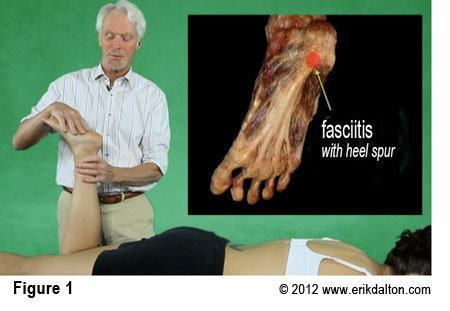
The plantar fascia is more than just a passive band of connective tissue originating at the calcaneal lip and attaching distally to the toes (Fig. 1). The plantar fascia and underlying muscles are part of an eloquent tensegrity spring system that uses a windlass mechanism to effectively absorb shock and spring us upward and onward (Fig. 2).
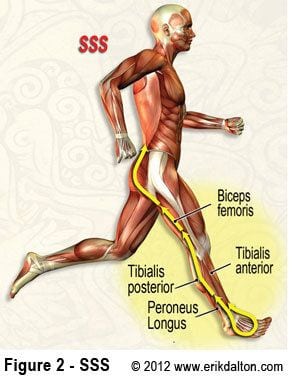
In a perfect walking stride, the person’s arch elevator muscles of the leg (tibialis anterior, peroneus longus and tibialis posterior) work in perfect harmony with the plantar-flexors (gastric, soleus, etc.) to absorb, distribute and release stored kinetic energy. On heel strike, the arch elevators must fire eccentrically to decelerate and dissipate ground reaction forces via foot pronation and internal tibial rotation.
As the foot transitions from midstance into push-off, the toes begin to dorsiflex causing activation of the plantar fascia and associated muscles. Due to the daily stresses placed on the foot and ankle, fascial adhesions of the posterior and lateral compartments are not uncommon. Manual therapists and athletic trainers often palpate dense fascial bag adhesions where the entire calf feels like a solid rock. So, how do these adhesions form?
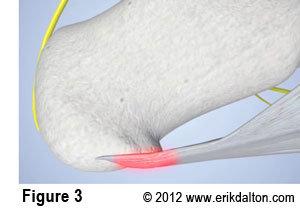
In 2009, Fernandez de las Penas found that eccentric contractions create fascial adhesions at a higher rate than concentric or isometric contractions1. Plantar fasciitis often results from lack of individuality of motion in the calf muscles due to adhesions. In time, loss of anti-gravity spring causes tissues of the arch to become irritated and inflamed. Bone spurs at the calcaneal tuberosity eventually form if this condition is not correctly treated (Fig. 3). Biomechanical faults or training flaws such as over-pronation, flat feet, a tight Achilles tendon, a high-arched foot, or a sudden increase in training mileage often cause plantar fasciitis.
Plantar fasciitis responds poorly to traditional treatment. Conventional therapy (without surgery) usually requires six weeks to three months. However, I’ve found that in contrast, some manual therapy techniques such as those demonstrated in the video below and more thoroughly in my Myoskeletal Alignment DVD set can resolve most cases within 6 to 9 treatments.
Myoskeletal Alignment focuses on four fundamental areas of soft tissue assessment:
- Tissue texture
- Tissue tension
- Tissue movement
- Tissue function
In order to achieve a high level of results when treating soft tissue conditions such as plantar fasciitis, history taking and hand-on assessments must be extremely specific regarding the nature of the lesion, the exact tissue involved, and the functional disturbance that caused it, and the functional disturbance it has created.